
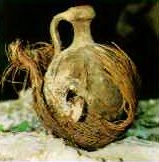
 The ancient Hebrews valued plant aromatics as medicinals and as perfume.
The two functions were closely intertwined, as attested to by the term
RAKAKHOT (I Sam. VIII : 13). The medieval commentator Rashi defined
it as "those who prepare salves and perfumes for women's cosmetics".
The ancient Hebrews valued plant aromatics as medicinals and as perfume.
The two functions were closely intertwined, as attested to by the term
RAKAKHOT (I Sam. VIII : 13). The medieval commentator Rashi defined
it as "those who prepare salves and perfumes for women's cosmetics".
The end result was of considerable financial worth, thus the perfumes and oils were stored in the king's warehouse (II Kings, XX: 13) and the Temple (I Chronicles IX: 30).
The production of plant aromatic products, salves, perfumes, and incense, was a highly skilled task. In the palace, the rakakhot were women whose profession was indeed this preparation; and in the Temple, the making was restricted to the members of one priestly family, where father and son handed down the professional secrets.
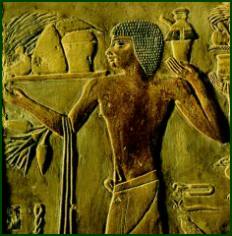 A suprising amount is known about the technical aspect of this work.
Michal Dage-Mendels, in her museum catalog (see bibliography),
describes the archeological findings. She chronicles the development
of extraction techniques.The ancients knew about different plant parts
that contain the aromatic materials, and used a variety of techniques
for production. Plant resins took especial skill at the harvesting stage
: cutting the bark and collecting the drops as they solidified. In the
most primitve stage, the oils were squeezed out of the plant materials.
Dage-Mendels describes a process where the bontanicals were put in cloth
strips that had sticks at each end. The sticks were twisted in opposing
directions and the oil squeezed out. The process was not very efficient,
and fairly large amounts of aromatic materials were left behind. Later,
the materials were soaked in hot water for a day before the sqeezing.
A suprising amount is known about the technical aspect of this work.
Michal Dage-Mendels, in her museum catalog (see bibliography),
describes the archeological findings. She chronicles the development
of extraction techniques.The ancients knew about different plant parts
that contain the aromatic materials, and used a variety of techniques
for production. Plant resins took especial skill at the harvesting stage
: cutting the bark and collecting the drops as they solidified. In the
most primitve stage, the oils were squeezed out of the plant materials.
Dage-Mendels describes a process where the bontanicals were put in cloth
strips that had sticks at each end. The sticks were twisted in opposing
directions and the oil squeezed out. The process was not very efficient,
and fairly large amounts of aromatic materials were left behind. Later,
the materials were soaked in hot water for a day before the sqeezing.
In the later, Mishnaic, period, under Hellenistic influence, two new techniques entered the repertoire: enfleurage and maceration. Enfleurage is used up to the present for rose oil, and maceration is also known to modern herbalists. Alcohol extraction was unknown, and the plant extracts were generally preserved in a carrier oil, the favorite being olive oil.
The resulting pruducts had many uses. For secular use, we know about oils being rubbed into hair, and the use of perfume and cosmetics. In the Temple, the resins and aromatic materials were ground into incense. We have many documents describing the preparation, many of them preserved as part of the prayers (for an example see the Appendix). Great care was preparing the mixture. The spice trade was an important part of the economy.
Notes relevant to this article will go here.